Written by Marcia Howards, Senior Associate Solicitor · SRA-regulated · Last reviewed 17 June 2026
1. Selecting Your UK Entry Structure
You must first choose how your international parent company (Inbound Franchisor) will hold its assets and manage operations.
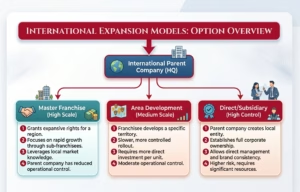 Master Franchise Agreement (Most Common): You grant a UK-based Master Franchisee the exclusive rights to act as the franchisor within the UK. They recruit, train, and support sub-franchisees.
- Pros: Rapid scale; utilises local market expertise; lowers your direct capital risk.
- Cons: You split royalty revenue; you lose direct operational control over individual units.
Area Development Agreement: You partner with a well-capitalised UK developer who commits to opening a specific number of corporate or joint-venture units within a set timeline and geographic territory. No sub-franchising is permitted.
- Pros: Protects brand integrity; simpler legal structure.
- Cons: Scale is limited by the developer’s internal capital and operational capacity.
-
Direct Franchising via a UK Subsidiary: You establish a UK corporate entity (e.g., a UK Limited Company) to act directly as the franchisor to individual local franchisees.
- Pros: Maximum revenue retention; total control over system standards.
- Cons: High initial setup costs; requires you to build a full UK-based support team from day one.
2. Legal Localisation: De-Americanising/De-Globalising Contracts
You cannot safely deploy your domestic franchise agreement in the UK. International agreements (especially US or Australian variants) must be fundamentally rewritten by UK franchise counsel to address three critical legal pillars:
Competition Law Restrictions
The UK has strict competition rules governed by the Competition Act 1998 and the Vertical Agreements Block Exemption Order (VABEO).
- Pricing: You cannot dictate mandatory or minimum resale prices to UK franchisees. You may only provide recommended retail prices (RRP) or maximum prices.
- Territory: You cannot completely ban a franchisee from accepting passive orders (unsolicited sales) from customers located in another franchisee’s territory.
Dispute Resolution & Jurisdiction
International agreements often mandate that disputes be settled in the home country’s courts under home-country law. UK courts look unfavourably on clauses that force a small UK franchisee into expensive foreign litigation. You must shift the governing law to English law and designate the courts of England and Wales (or London-based arbitration) as the venue.
IP Protection & Registration
The UK is no longer covered by EU trademarks. Before executing any agreement or revealing confidential manuals, you must register your brand name, logos, and proprietary software with the UK Intellectual Property Office (UK IPO).
3. Financial Mechanics & Banking Compliance
Securing funding for incoming franchisees is the single fastest way to scale a UK network.
The British Franchise Association (BFA) Gateway
While joining the BFA is voluntary, the UK’s major franchise lenders, such as HSBC UK, NatWest, and Barclays, have specialised, dedicated franchise departments. These banks will rarely lend money to your incoming UK franchisees unless your international system is formally accredited by the BFA, or passes their internal ethical structural audit.
Tax & Royalty Withholding
- Value Added Tax (VAT): Franchise fees, ongoing royalties, and marketing contributions levied within the UK are subject to UK VAT (currently 20%). Your financial models must account for this gross-up.
- Double Taxation Treaties: Ensure your corporate structure utilises the appropriate double-taxation treaty between your home nation and the UK to mitigate or eliminate withholding taxes on cross-border royalty transfers.
4. Immediate Action Checklist for Launch
- Register Trademarks & IP with the UK IPO
- Establish a UK Corporate Entity (Ltd) for Tax & Liability Isolation
- Rewrite Franchise Agreements to comply with UK VABEO Competition Law
- Submit System Documentation to major UK Banks for Financing Approval
- Launch a Proof-of-Concept Corporate Pilot Unit in a UK Urban Market