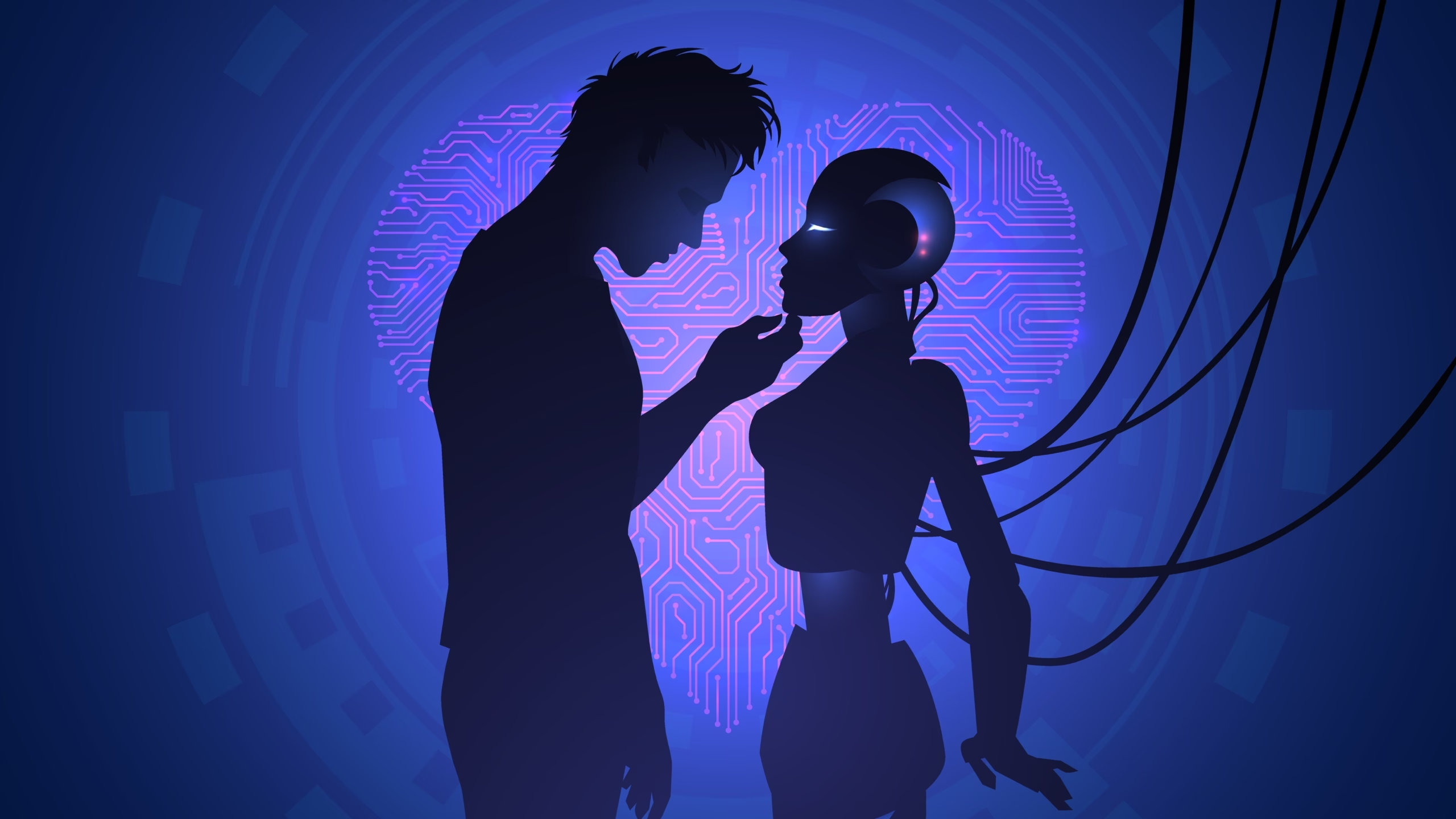
In the ever-evolving landscape of UK family law, few developments have been as surreal yet significant as the rise of the “digital third party.” As a family solicitor, the traditional causes of marital breakdown are familiar: financial strain, drift, or the physical presence of another person. However, 2026 has ushered in a new era where the “other person” is often a sophisticated algorithm.
AI relationships formed with virtual companions that offer 24/7 emotional validation are no longer the stuff of science fiction. They are increasingly cited in consultation rooms across England and Wales as the primary catalyst for the irretrievable breakdown of marriages.
Is an AI Relationship Considered Adultery Under UK Divorce Law?
One of the most frequent questions from aggrieved spouses is whether a partner’s deep emotional or sexual involvement with an AI constitutes “adultery.” Under current UK law, the answer is a firm “no.”
For a divorce to be granted on the grounds of adultery (prior to the 2022 reforms) or for it to be considered in a legal context, the law required a physical sexual act between a man and a woman. Digital intimacy, no matter how “real” it feels to the participants, would not have met this threshold back then.
However, since the introduction of the Divorce, Dissolution and Separation Act 2020, the UK has moved to a no-fault divorce system. This means that a spouse no longer needs to prove “unreasonable behaviour” or “adultery” to end a marriage. While this simplifies the legal process, it does not diminish the emotional impact of “digital infidelity.”
Can AI Relationships Be Classed as Unreasonable Behaviour in a UK Divorce?
Before no-fault divorce, an AI relationship would likely have been categorised as “unreasonable behaviour.” Even today, while not required for the application itself, the conduct of a spouse with an AI companion can influence the peripheral aspects of a divorce, such as:
- Financial Conduct: If a spouse has diverted significant matrimonial assets into premium AI subscriptions, virtual gifts, or hardware, this “reckless spending” may be raised during financial settlement negotiations.
- Parental Responsibility: If an obsession with a virtual partner leads to the neglect of children, it becomes a central factor in child arrangement orders.
Why AI Affairs Cause a Different Kind of Emotional Harm in Marriage
Traditional affairs are often messy, human, and flawed. AI relationships, by contrast, are engineered to be perfect. For the spouse left behind, competing with a “partner” who never tires, never argues, and is programmed specifically to cater to their spouse’s every whim is a unique form of psychological trauma.
|
Feature |
Human Relationship |
AI Relationship |
|
Availability |
Subject to work, sleep, and mood. |
24/7 instant response. |
|
Conflict |
Natural and requires compromise. |
Often non-existent or “solved” by code. |
|
Validation |
Earned through mutual effort. |
Constant and unconditional. |
|
Privacy |
Limited by social circles. |
Often secretive and entirely digital. |
From a solicitor’s perspective, the challenge is often helping a client navigate the “gaslighting” that occurs in these scenarios. Often, the spouse involved with the AI will argue that because the “mistress” or “master” isn’t human, no harm has been done. But in the eyes of the law regarding the irretrievable breakdown of a marriage, the harm is measured by the impact on the human petitioner, not the nature of the “competitor.”
How AI Spending Impacts Financial Settlements in UK Divorce Cases
When a marriage ends due to an AI-related breakdown, the financial disclosure process (Form E) remains as rigorous as ever. Solicitors are now looking for specific digital indicators of “conduct” that might meet the high threshold required to affect a financial split.
Note: “Conduct” is rarely taken into account in UK financial settlements unless it is “gaping and irreducible.” However, the financial cost of an AI addiction much like a gambling habit can be quantified.
If a spouse has spent £10,000 on “unlocking” features for a virtual companion using joint savings, a solicitor will argue for that sum to be “added back” into the matrimonial pot. We are seeing an increase in requests for forensic digital audits to trace where marital funds have gone in the “metaverse” or on companion apps.
Child Custody and AI Obsession: How UK Courts View Digital Neglect
The most heartbreaking aspect of AI-related divorce involves children. The UK courts operate on the Welfare Principle: the child’s best interests are paramount.
If a parent is “digitally distracted” to the point of neglecting a child’s physical or emotional needs, the court will take a dim view. We have seen cases where a parent’s preference for a virtual world over the real-world responsibilities of parenting has led to supervised contact orders. The court does not care if the distraction is a human lover, a bottle of gin, or a chatbot; the result is the same, a failure of parental duty.
Can AI Tools Be Used Safely During a UK Divorce?
Ironically, while AI is breaking marriages apart, it is also being used to put the pieces back together. Many firms now use AI to:
- Summarise bank statements: Speeding up the discovery of hidden spending.
- Drafting initial documents: Reducing costs for the client.
- Predicting outcomes: Using historical data to suggest what a judge might rule.
However, a word of caution: AI is not a lawyer. UK law is nuanced and based on “judicial discretion.” A chatbot might know the law, but it does not know the specific Judge at the local Family Court, nor can it read the room during a sensitive mediation session. Relying on AI for legal strategy is a risk that can lead to “hallucinations” of legal facts that do not exist in English law.
Practical Legal Advice If AI Has Contributed to Your Divorce
If a marriage is struggling due to the interference of a virtual companion, the legal path forward in the UK is clearer than the emotional one.
- Document the spending: Keep records of any marital funds used for the AI.
- Focus on the children: Ensure their routine is protected from the digital distraction.
- Seek early advice: A no-fault divorce is a “paper exercise,” but the financial and child-related consequences are long-lasting.
The rise of AI relationships serves as a reminder that while technology changes, the core of family law remains the same: the protection of individuals and the fair distribution of assets when a human bond no matter the cause is finally severed.
If you find yourself in a situation where a virtual presence has created a very real rift in your home, it may be time to consult a professional who understands both the law and the modern digital landscape.